



| Why Are Robotic Arms So Precise? Understanding Hypoid Gears: Principles, Advantages, and Applications |
 |
When it comes to high-precision transmission systems, Hypoid Gears are a type of gear commonly used in industry, although many people may not be familiar with them.
In recent years, with the rapid development of automation equipment, robotic arms, and smart manufacturing, transmission systems are no longer expected to provide only power. They must also deliver high precision, low noise, and stable operation. Hypoid gears are a transmission solution well suited for these demands.
From robotic arms and precision positioning equipment to advanced automation systems, hypoid gears can be found in a wide range of applications. Their biggest advantages are large tooth contact area, smooth operation, high rigidity, while also maintaining good transmission efficiency and low noise performance.
So, what exactly is a hypoid gear, and how is it different from ordinary gears?
What Is a Hypoid Gear? How Is It Different from Ordinary Gears?
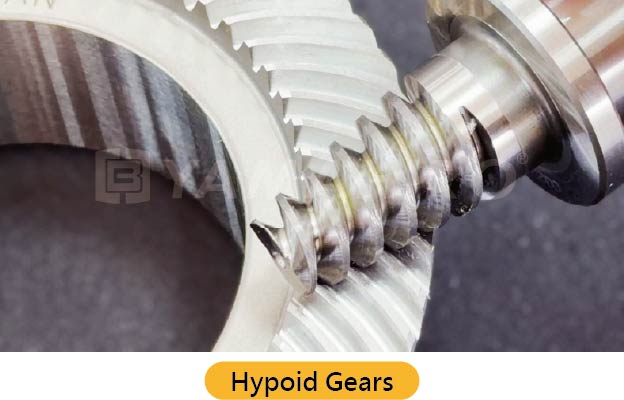
A hypoid gear is a special type of bevel gear transmission structure. Its most distinctive feature is that the two transmission shafts do not completely intersect, but instead use an offset design.
Compared with ordinary gears, hypoid gears feature three-dimensional curved tooth surfaces, deeper tooth geometry, and a larger contact area. During operation, the transmitted force is not concentrated at a single contact point. Instead, it is distributed more evenly across a larger tooth surface area, which helps reduce vibration and impact.
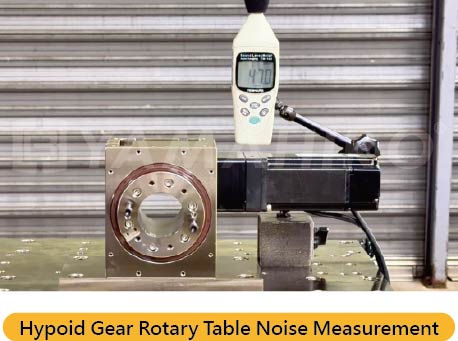
Because of this larger contact area, hypoid gears can maintain smooth and stable operation even under high loads, while also providing lower noise performance.
| Compared with traditional gears, hypoid gears typically offer the following characteristics: • Larger tooth surface contact area • High operational stability • Lower noise levels • Higher rigidity • Suitable for high-load and high-precision transmission applications This is why hypoid gears are commonly used in precision machinery and advanced automation equipment. |
 |
Transmission Principles of Hypoid Gears
The transmission mechanism of hypoid gears falls between helical gears and worm gears.
They are not purely rolling contact like helical gears, nor do they rely heavily on sliding friction like worm gears. Instead, hypoid gears use large-area tooth surface engagement to distribute force more evenly during transmission.
As hypoid gears operate, the tooth surfaces engage in a continuous and progressive manner. This helps reduce sudden impact and vibration during power transmission, resulting in smoother overall operation.
In addition, the offset design of hypoid gears provides greater flexibility in structural layout, allowing them to achieve both high torque and high rigidity within limited installation space.
In simple terms, hypoid gears offer several key transmission characteristics:
• High transmission stability
• Excellent load-carrying capability
• Lower noise levels
• Stable torque output
• Outstanding rigidity and precision
Because of these advantages, hypoid gears are especially suitable for equipment that requires long-term, high-precision operation.
Manufacturing Process of Hypoid Gears
Compared with ordinary gears, hypoid gears are more difficult to manufacture.
Because hypoid gears feature three-dimensional curved tooth surfaces, the machining process involves much more than simply cutting gear teeth. Every angle and tooth surface contact geometry must be precisely controlled to ensure proper meshing accuracy.
| Typical manufacturing processes for hypoid gears include: • Rough machining • Five-axis machining • Heat treatment • Tooth surface grinding • Precision finishing and correction machining |
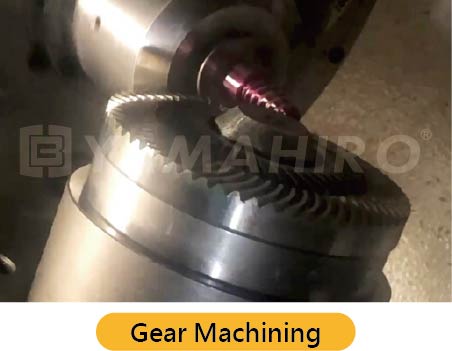 |
Among these processes, five-axis machining is one of the most critical steps in hypoid gear manufacturing. Due to the complex tooth surface geometry of hypoid gears, multi-axis synchronized machining is required to produce the correct curved tooth profile.
After machining is completed, multiple grinding and correction processes are usually performed to improve tooth contact accuracy and reduce operational error and noise.
Because of the high manufacturing complexity, hypoid gears require extremely high standards in machine precision, machining technology, and measurement capability.
How Are Hypoid Gears Measured and Inspected?
Because hypoid gears feature more complex tooth surface structures, their measurement and inspection processes are even more important than those of ordinary gears.
| Common inspection items for hypoid gears include: • Tooth profile measurement • Tooth contact pattern inspection • Transmission error testing • Gear meshing accuracy inspection |
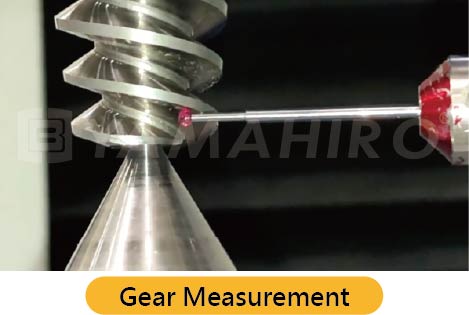 |
Among these inspections, tooth contact pattern analysis is one of the most important for hypoid gears. Since hypoid gears transmit force through large-area tooth surface contact, the uniformity and stability of the contact pattern directly affect operational performance.
Transmission error is also a critical indicator. By measuring variations during rotation, it is possible to verify whether the gear can maintain stable and smooth operation under high-speed or high-load conditions.
Especially in precision equipment, even very small errors can affect positioning accuracy and overall system performance.
Advantages of Hypoid Gears
The greatest advantage of hypoid gears is their ability to combine high rigidity, high precision, and low noise performance at the same time.
Because they have a larger tooth surface contact area, loads can be distributed more evenly during power transmission, reducing localized stress and vibration. Even under high-load operating conditions, hypoid gears can still maintain stable and smooth performance.
| Compared with other transmission systems, hypoid gears offer several significant advantages: 1. High Rigidity The offset design combined with large-area tooth surface contact improves overall structural rigidity, making hypoid gears suitable for high-load applications. 2. High Precision Stable tooth surface engagement helps maintain excellent positioning accuracy and transmission stability. 3. Low Noise The smoother tooth meshing process effectively reduces vibration and operating noise. 4. Stable Torque Output Even under increased loads, hypoid gears can still maintain smooth and stable power transmission. 5. Suitable for Precision Equipment They are especially suitable for equipment requiring high-precision control and long-term operation. |
 |
Common Applications of Hypoid Gears
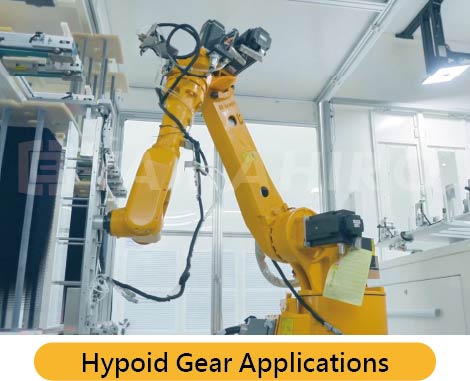
In recent years, hypoid gears have become increasingly common in automation equipment and robotic arms.
During operation, robotic arms must simultaneously maintain load capacity, positioning accuracy, and smooth motion. As a result, the transmission system requires high rigidity and stable torque output—both of which are key advantages of hypoid gears.
Compared with ordinary gears, hypoid gears provide a larger tooth surface contact area, allowing them to maintain smooth operation, low vibration, and low noise even under high-load conditions. This makes them especially suitable for precision control equipment.
| In addition to robotic arms, hypoid gears are also widely used in: • Precision positioning platforms • CNC machine tools • Automation equipment • Semiconductor equipment • High-precision rotary tables • Industrial robots |
 |
Especially in equipment that requires long-term, high-precision operation, hypoid gears can effectively improve overall stability and transmission performance.
Conclusion: Why Are Hypoid Gears Becoming More Important?
With the rapid development of automation and smart manufacturing, transmission systems are no longer expected to simply "move." Today, the industry places greater emphasis on:
• High precision
• High rigidity
• Low noise
• Operational stability
• Long-term operating capability
( Related Reading How to Install Large Worm Gear Rotary Tables? | Knowledge Sharing EP.11 – Installation and Technical Considerations for Large Rotary Tables )
Herbao Machinery will continue driving technological innovation and providing customers with more professional and reliable solutions.
If you have any technical questions, feel free to contact us!