




| Understanding Worm Gears: Applications of High-Torque and Self-Locking Transmission |
 |
When it comes to transmission systems that offer high torque and self-locking capability, the worm gear is undoubtedly one of the most representative gear types.
Thanks to its unique transmission characteristics, worm gears are widely used in applications that require low-speed operation, high load capacity, and back-drive prevention. Common examples include elevators, floodgates, lifting platforms, positioning mechanisms, and gear reducers, where worm gear systems play a critical role in ensuring stable and reliable operation.
What Is a Worm Gear? How Is It Different from Ordinary Gears?
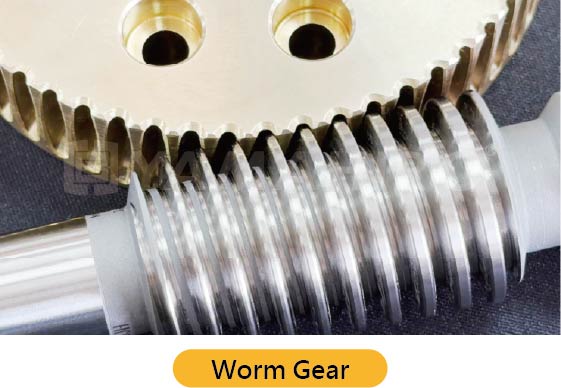
A worm gear is a transmission system composed of a worm and a worm wheel. The worm resembles a screw, while the worm wheel looks similar to a disc-shaped gear. As the worm rotates, it drives the worm wheel, allowing power to be transmitted from one shaft to another.
The biggest difference between a worm gear and ordinary gears is that worm gears rely on sliding contact transmission. Because power is transmitted through sliding friction, worm gears can achieve very high gear reduction ratios within a compact design.
Another notable characteristic of worm gears is their self-locking capability. Simply put, when the input shaft stops rotating, it becomes difficult for the output shaft to back-drive the input shaft. This helps prevent reverse movement and improves operational safety.
This unique feature is one of the main reasons why worm gears are widely used in elevators, lifting platforms, and gate systems.
| Compared with ordinary gears, worm gears typically offer the following characteristics: • High gear reduction ratios • High torque output • Self-locking capability • Suitable for low-speed, high-load applications • Stable operation |
 |
Transmission Principles of Worm Gears
Worm gears transmit power primarily through sliding friction. As the worm rotates, it drives the worm wheel in much the same way that a screw drives a nut, causing the wheel to rotate gradually. This unique mechanism allows worm gears to achieve high gear reduction ratios and high torque output within a compact space.
In simple terms, worm gears offer several key transmission characteristics:
• High reduction ratios
• High torque output
• Self-locking capability
Among these features, self-locking capability is one of the most distinctive advantages of worm gears. Once the system stops operating, the output shaft is unlikely to move backward or slip, making worm gears ideal for applications that require position holding, load support, or back-drive prevention.
However, because worm gears rely on sliding friction for power transmission, they generate more heat and energy loss during operation. As a result, their transmission efficiency is generally lower than that of helical gears or hypoid gears.
Manufacturing Process of Worm Gears
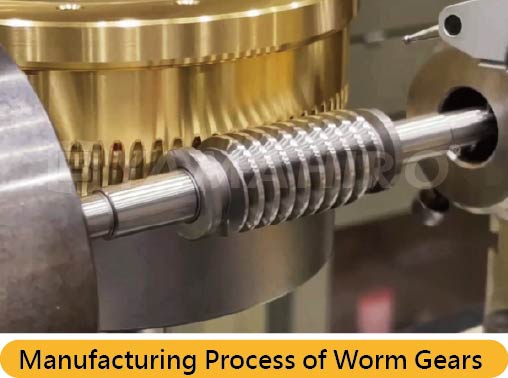
Because worm gears consist of a worm and a worm wheel that operate as a matched pair, the tooth profile, lead, and contact accuracy of both components must be precisely matched to ensure smooth and stable operation.
| Typical manufacturing processes for worm gears include: • Turning • Gear hobbing • Heat treatment • Tooth surface grinding • Gear meshing correction and finishing |
 |
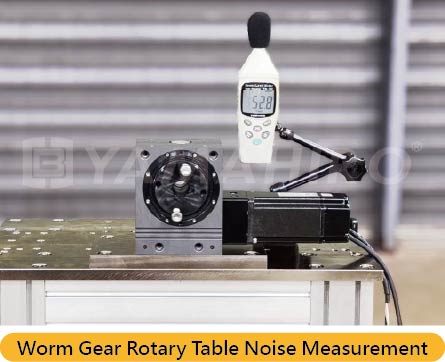
Among the various inspection items, transmission error is particularly important. By measuring variations in rotational error during operation, engineers can verify whether the worm gear system maintains smooth and stable performance under low-speed, high-load conditions.
How Are Worm Gears Measured and Inspected?
In addition to tooth profile accuracy, the measurement and inspection of worm gears place special emphasis on overall meshing performance and transmission stability. Any errors in tooth geometry, lead accuracy, or contact position can increase friction and noise, while also affecting transmission efficiency and service life.
• Tooth profile measurement
• Lead accuracy inspection
• Transmission error testing
• Gear meshing contact inspection
Among these inspections, transmission error is one of the most critical indicators. By measuring variations in rotational error throughout operation, engineers can verify whether the worm gear system maintains smooth and stable performance under low-speed, high-load conditions.
Advantages of Worm Gears
The greatest advantages of worm gears are their ability to provide high torque, high reduction ratios, and self-locking capability in a single transmission system.
| Compared with other transmission methods, worm gears offer several distinct benefits: 1. High Reduction Ratio Even with a single-stage transmission, worm gears can achieve significant speed reduction, making them ideal for applications with limited installation space. 2. High Torque Output Worm gears can convert rotational speed into greater torque, making them well suited for high-load applications. 3. Self-Locking Capability After the system stops operating, the output shaft is difficult to back-drive, effectively preventing reverse movement. 4. Smooth Operation Due to their continuous tooth engagement, worm gears provide stable and smooth performance, especially at low speeds. 5. Suitable for Positioning and Lifting Equipment Worm gears are particularly well suited for applications that require position holding, load support, and reliable motion control. |
 |
Common Applications of Worm Gears
Because worm gears offer high reduction ratios, high torque output, and self-locking capability, they are particularly suitable for applications that operate under heavy loads and require back-drive prevention.
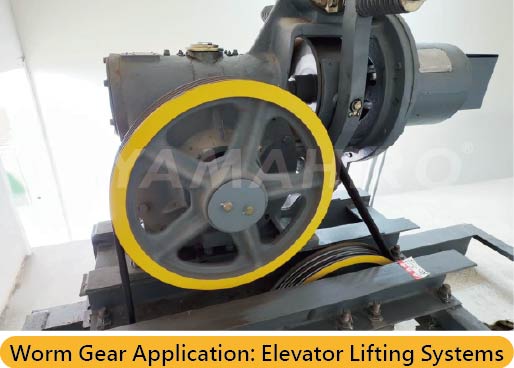
One of the most common applications is elevator systems. In addition to supporting heavy loads, elevators must remain stable when stopped and prevent unintended movement caused by external forces. The self-locking characteristic of worm gears makes them an ideal solution for this requirement.
| In addition to elevators, worm gears are widely used in: • Gate systems • Lifting platforms • Industrial gear reducers • Conveyor systems • Positioning mechanisms • Automation equipment |
 |
For equipment that requires stable control, reliable positioning, and enhanced safety, worm gears remain a proven and dependable transmission solution.
Conclusion: Why Are Worm Gears Still Widely Used Today?
Although transmission technologies continue to evolve, worm gears remain an essential component in many industrial applications due to their unique combination of high torque, high reduction ratios, and self-locking capability.
These characteristics make worm gears a reliable choice for equipment that requires stable operation, load-holding capability, and enhanced safety.
( Related Reading How to Install a Large Worm Gear Rotary Table? Knowledge Sharing No.11 – Installation and Technical Considerations for Large 4th-Axis Rotary Tables )
Herbao Machinery will continue to drive technological innovation and provide customers with professional and reliable solutions.
If you have any technical questions, please feel free to contact us. We are always happy to help!